Jebel Harim Mountain Safari in Musandam, Oman: Route & Best Stops
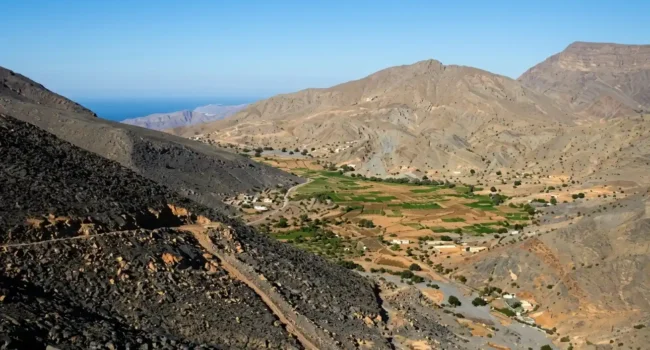
Most people come to Musandam for the boats. But the mountains are just as impressive, and many visitors say the Jebel Harim mountain safari is the best surprise of their trip.
In just a few hours, you leave the sea behind and climb into a dry, rocky world with huge views, ancient fossils and quiet mountain villages. This guide explains the route, the stops, what to bring, and whether you need a 4×4 or a guided tour.
What Is Jebel Harim?
Jebel Harim is the highest peak in Musandam. It rises to about 2,087 metres above sea level. The name is often translated as “Mountain of Women.”
You cannot just walk to the top. There is a radar station near the summit, which watches ships in the Strait of Hormuz far below. Tours drive up close to the top, so you still get wide views of the Hajar Mountains.
What Is the Jebel Harim Mountain Safari?
A mountain safari is a guided drive in a 4×4 vehicle through the Musandam mountains. It starts in Khasab, the main town, and usually lasts 3 to 4 hours. It is a calm tour, not a wild ride. You sit in the car, stop at viewpoints, step out for photos and learn about the land from your driver.
The Route and Main Stops
Different companies change the order a little, but most tours follow a similar path.
1. Leaving Khasab
You are picked up from your hotel or from the cruise port, and the road begins to climb. Within minutes, the town gets smaller and the mountains get bigger. The road turns steep, with sharp bends, so the guide drives slowly.
2. Khor Najd Viewpoint
On the way up, you stop at several viewpoints. Each one shows a new angle of the rocky slopes and valleys. On clear days, you can see far across the land and out to the sea. Many tours end at the famous Khor Najd viewpoint, where a deep fjord cuts through the mountains. It is one of the most photographed spots in Musandam. Stay well back from the edge, as the drop is steep. You can read more in our full guide to the Khor Najd viewpoint.
3. Sayh Plateau and the Bedouin Village
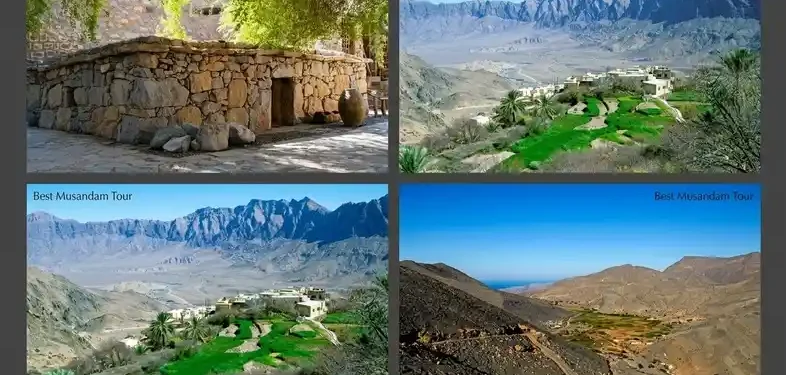
Sayh is a small village on a plateau about 1,100 metres above sea level. Life here is quiet, and the air feels cooler and fresher than in Khasab. You can see how traditional mountain communities live, with simple homes, goats and open land.
Be polite if you take photos. Ask before you photograph people, especially women and children.
4. Near the Summit of Jebel Harim
Next, you drive up close to the top of Jebel Harim. This is the highest point on the tour. Here the view is wide, and you can see the Hajar Mountains stretch out in all directions. On a clear day, you may even spot the coast far below.
5. Fossil Rocks
This is one of the favourite stops. Many rocks along the road are full of fossils from millions of years ago, when this area was under the sea. You can see shapes that look like shells and other sea life with your own eyes. Some tours stop at a rock wall that is covered in fossils. Take a moment to look closely. It is a real piece of history.
Please remember: Look and take photos, but do not break rocks or take fossils home. Leave them for the next visitor.
6. Bait Ul Qufl: Traditional Mountain Storage Houses
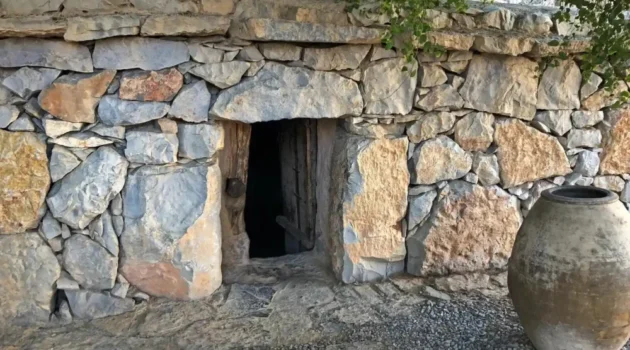
Bait Ul Qufl is a traditional stone storage structure found in the Musandam region. Its name is commonly translated as “House of the Lock.” These sturdy structures were built to help local communities store and protect valuables, food supplies and other belongings.
Built using stone and traditional construction methods, Bait Ul Qufl reflects how people adapted to life in Musandam’s rugged mountain environment. It offers a glimpse into the area’s heritage beyond its dramatic landscapes and coastal scenery.
If your Jebel Harim mountain safari includes a stop here, take time to appreciate the traditional architecture and learn from your guide about its historical purpose. Remember to respect the site and avoid entering restricted areas or disturbing the structure.
7. Khalidiya Acacia Park (on Some Tours)
Some safaris also stop at Khalidiya Acacia Park, a small green area of acacia trees. After so much dry rock, the shade and green leaves are a nice change. Ask your tour company if this is included.
Sample Half-Day Itinerary
| Time | What happens |
|---|---|
| 9:00 AM | Pick-up from your hotel in Khasab |
| 9:30 AM | Climb into the mountains, with viewpoint stops |
| 10:15 AM | Khor Najd viewpoint |
| 10:45 AM | Sayh village and plateau |
| 11:30 AM | Drive near the summit of Jebel Harim |
| 12:00 PM | Fossil rocks and photo stops |
| 12:30 PM | Return to Khasab |
Times are only an example. Your tour may start earlier or later, depending on your preferred schedule.
Do You Need a 4×4?
Yes, for this route. The mountain roads are steep, twisty and rough in places. A normal car is not a good idea. Tours use 4×4 vehicles because they handle loose stones and sharp climbs much better.
Some visitors drive up to Khor Najd in an ordinary car, but the full Jebel Harim route is harder. If you rent a car, check your rental terms first. Many do not cover mountain tracks.
Guided Safari or Self-Drive?
Why Choose a Guided Safari
- Safer. The driver knows the road, the weather and the hard sections.
- Easier. You can relax and look at the view instead of the road.
- More interesting. Guides explain the fossils, the villages and the local way of life.
- No navigation worries. Phone signal can be weak in the mountains.
- Good for families and older travelers. You do not need any off-road skills.
When Self-Drive Might Work
- You have a strong 4×4 and mountain driving experience
- You want to stay as long as you like
- You are comfortable with steep and loose roads
For most visitors, a guided safari is the better choice. It is simpler and more relaxing, and you learn a lot more along the way.
How Much Does It Cost?
Prices change by season and company. Booking sites show roughly $180 to $190 per vehicle for a half-day private tour. If you book a full car, a private tour often costs less per person if you are in a group of 4 to 5 persons.
Always check what is included. Most tours offer hotel pick-up, a guide, and water or juice. Some also offer snacks.
Best Time to Go
The best time for a mountain safari is November to March.
- The air is cooler, so walking is more comfortable.
- The skies are often clear for photos.
- The roads are usually dry and safer.
You can also go in October and April. In summer, it gets very hot, so choose a morning tour and bring plenty of water.
Avoid going just after rain. Mountain roads can be slippery, and some tracks may be closed. Your tour company will know the current situation.
Best time of day: morning or around midday. The light is bright, the views are clear, and you will be back before dark.
What to Bring
- Water. More than you think you need.
- Sunscreen, hat and sunglasses. The sun is strong at high altitude.
- Comfortable shoes. The ground is rocky and uneven.
- A light jacket. It can be windy and cool at the top, especially in winter.
- Camera or phone, plus a power bank.
- Snacks. Useful, especially with children.
- Cash in small notes. Handy for tips or village shops.
- Motion sickness tablets. Ask your pharmacist if you get car sick, as the roads have many bends.
Safety and Respect Tips
- Keep your seat belt on. The road is bumpy and steep.
- Stay behind the edges. Drops can be sharp, with few barriers.
- Watch children closely. Keep them near you at every stop.
- Listen to your guide. They know what is safe.
- Dress modestly in villages. Cover your shoulders and knees.
- Photos. Ask before taking photos of people.
- Fossils & Rocks. Do not remove fossils or rocks.
- Trash. Never throw rubbish into the mountains or leave it behind.
Is the Jebel Harim Mountain Safari Good for Kids?
Yes, for most children. The ride is exciting, the fossils are fun to spot, and the views are amazing. But the roads are bumpy and twisty, so it can be tiring for babies and toddlers. Bring snacks, water and car seats if your tour allows.
Can You Combine It with a Boat Trip?
Yes, and this is the best way to see Musandam. Many visitors do a dhow cruise one day and a mountain safari the next. If you only have a short time, you can do the safari in the morning and a half-day cruise in the afternoon, but check with your tour company first.
If you stay overnight in Khasab, you will have a much easier time fitting both in. You can read our guide on the Musandam day trip vs. overnight stay to plan your days.
Frequently Asked Questions
How long is the Jebel Harim mountain safari?
Most tours take about 3 to 4 hours, including photo stops.
Can you reach the very top of Jebel Harim?
Not exactly. There is a radar station at the summit, so tours drive close to the top instead and stop at viewpoints.
Is the safari suitable for older people?
Usually yes. You stay in the vehicle for most of the trip, and stops involve only short walks. Tell your tour company about any health concerns first.
Do I need to book in advance?
It is smart to book ahead in winter, when tours are busiest. Outside peak season, you may find last-minute spots.
Final Thoughts for Jebel Harim Safari Trip
The Jebel Harim mountain safari shows a very different side of Musandam. You see fossils from the ancient sea, a quiet mountain village, huge views and one of the best viewpoints in Oman, all in a few hours.
Take a 4×4 with a local guide, go between November and March, and bring water, sun protection and a camera. Pair it with a dhow cruise, and you will see the best of both the sea and the mountains.